

Banqer is a financial literacy platform used by over 600,000 students across Australasia. It turns your classroom into a virtual economy where students earn, save, spend, and deal with unexpected financial curveballs; all using simulated money. Think of it as online banking for kids, but with the chaos, competition, and teachable moments dialled up to eleven.
I've been using Banqer Primary in my Year 5 classroom for a while now, and I have some strong opinions about it. Here's my honest take; what works, what doesn't, how I actually run it, and whether it's worth your time.
What is Banqer?
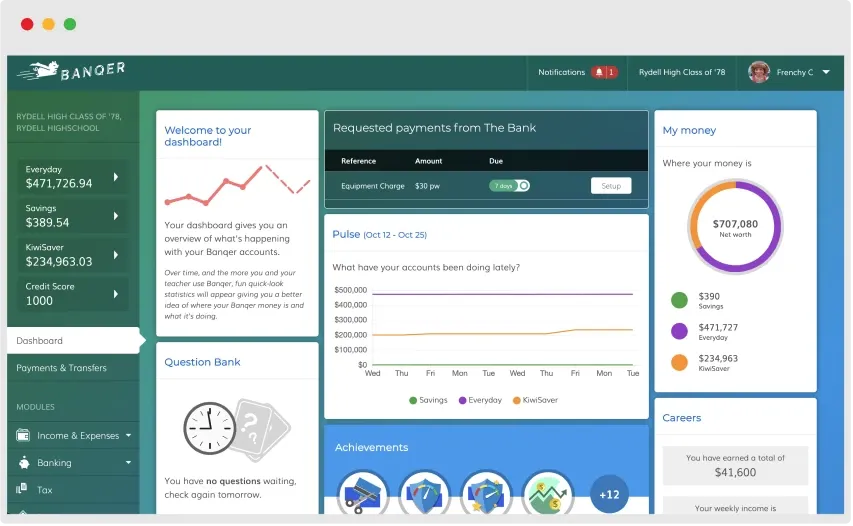
Banqer is an experiential learning platform built specifically for financial education. Rather than worksheets and textbook definitions, students interact directly with a simulated financial world. They open bank accounts, earn a class salary, pay expenses, get hit with random events (surprise car breakdown, anyone?), and make real decisions about saving versus spending.
It was founded in New Zealand and is now used widely across Australia and beyond. The key insight behind it is simple: kids learn money skills better by doing them than by hearing about them. A student who has to decide whether to spend their Banqer dollars on a class auction prize or save for a mortgage deposit understands compound interest in a way no textbook lesson can match.
After using Banqer with my own Year 5 students, I can confirm: the engagement is real. The kids talk about their Banqer accounts. They check their balances. They get annoyed when they're taxed. That's exactly the point.
Which version do you need?
Banqer comes in three tiers designed to grow with your students:
Banqer Primary: designed for Years 4 - 6 (also used in Years 2 - 3). This is the one I use. It covers the fundamentals: income, expenses, banking, tax, savings accounts, and property basics. Perfect for upper primary classrooms and a great introduction to a classroom economy. Aligned with the Australian Curriculum across maths, English, and civics.
Banqer High Junior: for Years 7 - 10. Goes deeper into budgeting, careers, investments, and financial decision-making. More complex scenarios and a self-paced format that suits secondary students well. Used in Humanities, Business/Commerce, and Mathematics classes.
Banqer High Senior: for Years 10 - 12. Focuses on life after school: loans, superannuation, insurance, renting, and investing. Largely student-led and self-paced, simulating the financial decisions students will face between ages 17 - 22.
What does Banqer actually teach?
Across all versions, Banqer covers a solid range of financial concepts through videos, quizzes, simulated events, and interactive modules. In Banqer Primary, students experience:
- Income and earning: students apply for class jobs and receive a weekly salary
- Banking and transactions: transferring funds, setting up automatic payments, monitoring balances
- Taxes: yes, the kids pay tax, and yes, they hate it (which is perfect)
- Expenses and budgeting: managing regular outgoings like rent, iPad hire, or class levies
- Savings and interest: putting money away and watching it grow
- Property: basic introduction to mortgages and property decisions
- Random events: unexpected bills or windfalls that mirror real-life financial surprises
One of the most powerful features is the random events system. When a student suddenly gets hit with an unexpected expense (a stolen bike, a broken device, an unexpected medical bill) you see genuine problem-solving kick in. They have to decide: dip into savings, go without, or borrow? That's a real-world skill playing out in a safe environment.
Banqer as a classroom reward system
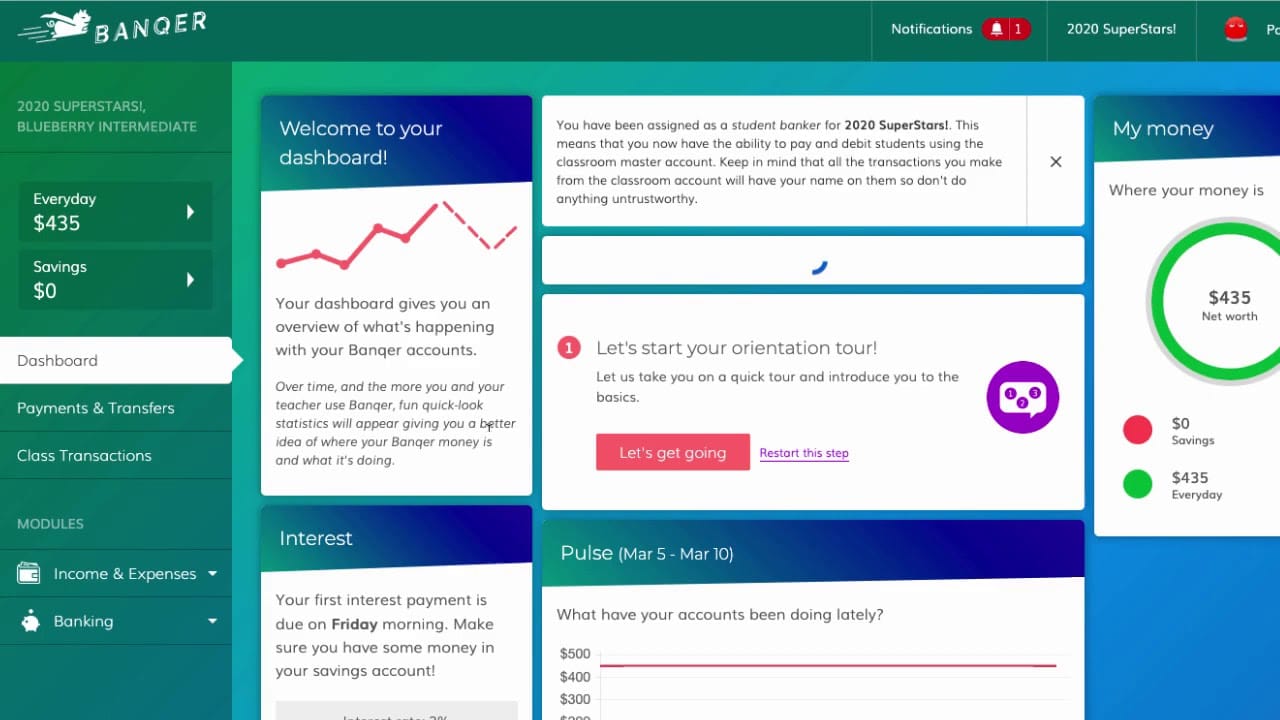
This is how I primarily use Banqer, and it's where I've seen the most impact. Rather than just running the financial modules in isolation, I've woven Banqer's virtual economy into how my classroom runs day-to-day.
Students earn their Banqer salary through class jobs: librarian, door monitor, tech support, and more. Positive behaviour, completed work, and classroom responsibilities all feed into what they earn. They then have expenses: iPad hire, desk rent, and occasional levies I add throughout the term.
At the end of term, we run a class auction. Students bid using their Banqer dollars on prizes: homework passes, extra reading time, picking the class movie, small treats. The lead-up is the best part: students who've been saving strategically through the term suddenly have serious bidding power over those who spent freely early on. That lesson lands harder than any worksheet about savings ever could.
If you want a deeper dive into running a full classroom economy alongside Banqer, check out my guide to a classroom economy in upper primary.
Banqer hacks and tips
This is the section a lot of teachers don't find until they've been using Banqer for a while. Here's what I've learned the hard way so you don't have to.
Start small, then add modules gradually. Don't activate everything at once. Begin with class jobs, salary, and a savings account. Once students are comfortable, add expenses, then tax, then property. Trying to do it all in week one overwhelms both you and the kids.
Use automatic payments for recurring expenses. Setting up automatic weekly payments for things like desk rent or iPad hire removes admin from your plate and teaches students to plan ahead. If their account hits zero and an automatic payment is due, the consequences play out naturally.
Run a class auction at the end of each term. This is the event students work toward all term. Keep a prize box throughout the term (homework passes, choice of game, small items) and let students bid competitively. The anticipation drives saving behaviour far more effectively than talking about saving ever will.
Steal money from students' accounts occasionally. I know this sounds alarming, but hear me out. Several teachers in the Banqer community do this to simulate theft or a random financial event. It teaches students to check their accounts regularly and builds the habit of monitoring their finances. The outrage is instructive.
Use auctions to teach about scarcity. Put only one of a highly desired prize in the auction. Watch students learn quickly about bidding wars, price inflation, and the cost of wanting something everyone else wants.
Connect it to maths lessons. Banqer has curriculum connections built in across maths, English, and civics, and they're listed on the Banqer website. Teaching percentages? Run a Banqer interest rate activity alongside it. Teaching probability? Use random events as a launching point.
Let students run class companies. Some teachers allow students to create their own in-class businesses, selling services to classmates using Banqer dollars. This adds an entrepreneurship layer that older primary students love.
Introduce debt carefully. Some teachers allow students to go into negative balance (debt), charging Banqer interest on what they owe. This is a powerful lesson but works best with Year 5 and above once the foundations are solid.
Pros and Cons
| Banqer | |
|---|---|
| Engagement | Genuinely high — students check balances voluntarily and talk about it at home |
| Setup time | Low — takes about 30 minutes to set up a class initially |
| Curriculum alignment | Strong — maths, English, and civics links with downloadable lesson plans |
| Ongoing admin | Minimal once automatic payments are configured |
| Depth of content | Good for primary; High versions go deeper for secondary |
| Random events | Excellent — create real teachable moments around financial resilience |
| Cost | Free for Australian primary schools (sponsored by Netwealth) |
| Limitations | Requires some classroom buy-in to run well; less impactful used passively |
| Best for | Years 4–6 primary; also strong in Years 7–10 via Banqer High |
| Not ideal for | Teachers wanting a fully self-running program with no involvement |
Verdict: 4.5 / 5
Banqer is one of the most genuinely useful digital tools I use in my classroom. The engagement is real, the financial concepts are solid, and the fact that it's completely free for Australian primary schools removes the biggest barrier. The only reason it doesn't get a perfect score is that it rewards teachers who invest time in running it well. Used passively, it loses some of its power.
How much does Banqer cost?
Banqer Primary is completely free for Australian primary schools, sponsored by Netwealth. There are no hidden costs, no per-student fees, and no premium tier to unlock. You register, create your class, and get started.
Banqer High (Junior and Senior) is a paid product for secondary schools, with tailored pricing based on the number of licences and multi-year use. Pricing is subsidised by partner organisations and you'll need to contact Banqer directly for a quote. Head to banqer.co/au to get started or book a demo.
For homeschool families, Banqer Primary is available for $75 AUD per child per year.
Alternatives to Banqer
If you're weighing up your options, here are the main alternatives:
Banzai is a free financial literacy platform popular in US schools, used by over 120,000 teachers. More worksheet-style than Banqer's simulation approach. Good for older students and individual work, but lacks the classroom economy element that makes Banqer so engaging.
Kid's Coin is a New Zealand-based digital platform covering banking, e-commerce, and taxes using simulated bank accounts. Similar concept to Banqer Primary, particularly popular in NZ schools.
A physical classroom economy. If you'd prefer something entirely offline, running a paper-based classroom economy is absolutely viable. I wrote about how to do this in my guide to a classroom economy in upper primary. The advantage is total teacher control; the downside is more admin on your end.
My verdict
Banqer is the rare ed-tech tool that actually does what it promises. The kids love it, the financial concepts stick, and the classroom economy angle gives you a behaviour management system and a financial literacy program in one. For Australian primary teachers especially, the fact that it's completely free makes it a no-brainer to at least try.
The key is running it actively rather than passively. Set up class jobs, run the auction at the end of term, use the random events as discussion starters, and let the students feel the consequences of their financial decisions. Do that, and Banqer becomes one of the most memorable things your students do all year.
Ready to get started? Head to banqer.co/au to register your class — it takes about 30 minutes to set up.
Looking for more classroom tools worth your time? Check out my reviews of Sumdog, ClassDojo, and LessonUp.
